
- Cet évènement est passé.
Critical Heritage Studies in the Post-Socialist Space. Vulnerable Past Uncertain Future Institutionalization of Heritage in Times of Crisis
04/11/2025 /17h30 - 19h30
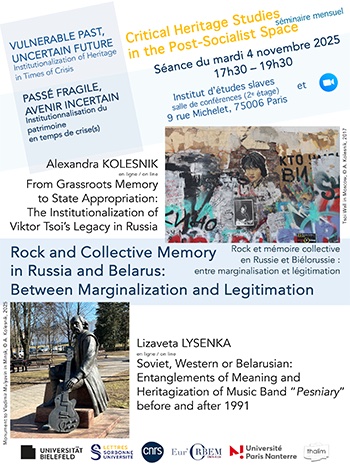
Rock et mémoire collective en Russie et Biélorussie : entre marginalisation et légitimation
Rock and Collective Memory in Russia and Belarus: Between Marginalization and Legitimation
- Alexandra KOLESNIK (Bielefeld University) :
«Rock, Memory, and Conflicts: The Heritagization of Soviet Rock Music in the Post-Soviet Space»
This paper examines the contested heritage of Viktor Tsoi, the iconic Soviet rock musician whose memory remains central across the post-Soviet space. Since 1990, fan memorials — walls, plaques, museums, and concerts — have functioned as grassroots lieux de mémoire, fostering transnational networks of remembrance. Yet over the past decade, Tsoi’s legacy has been increasingly appropriated by the Russian state. His music and image have been reframed as patriotic heritage, culminating in their militarized use after the 2022 invasion of Ukraine, when his songs and image were mobilized in propaganda and Victory Day rituals. Drawing on interviews, digital ethnography, and fieldwork, the paper situates this process of institutionalization within broader debates on authoritarianism and cultural resistance. It argues that the struggle over Tsoi’s legacy illustrates how popular culture becomes a contested political resource, exposing the tension between bottom-up memory practices and state-driven heritage regimes. - Lizaveta LYSENKA (Kaiser-Friedrich-Wilhelm Universität Bonn) :
«Soviet, Western or Belarusian: Entanglements of Meaning and Heritagization of Music Band “Pesniary” before and
after 1991»
The Belarusian music band Pesniary began their career in 1969. The band’s music and visual style exemplify a complex interplay of Western, Soviet, and Belarusian cultural influences. In post-Soviet Belarus their music acquired the status of national heritage, becoming a subject of debate within competing discourses on Belarusian national identity. These discourses emphasize selective aspects of the band’s significance within Soviet and Belarusian culture. The Belarusian state became the custodian of Pesniary’s legacy, using it to reinforce the narrative that the Soviet past is the most (if not the only) significant period of Belarusian history. Meanwhile, opponents of the state regime reimagined the band’s songs, constructing a canon of national history in which Pesniary is the voice of the Belarusian people, but without the Soviet element of their eclectic repertoire. In this narrative, the « Westernness » of the band came to the forefront. This paper explores the antagonistic discourses of national identity, comparing them to the Pesniary’s reception during the Soviet time to showcase how heritage discourse transforms popular music into a representation of the past.
Zoom Inscription : aleksandra.kolesnik@uni-bielefeld.de