
- Cet évènement est passé.
Critical Heritage Studies in the Post-Socialist Space. Vulnerable Past Uncertain Future Institutionalization of Heritage in Times of Crisis
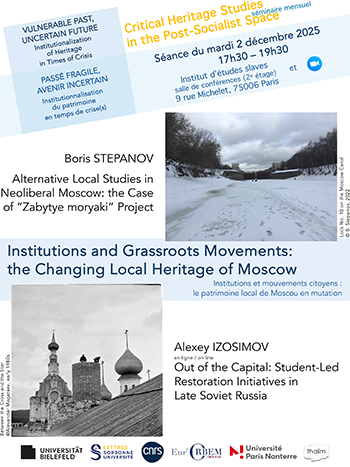
Institutions et mouvements citoyens : l’héritage local de Moscou en mutation
Institutions and Grassroots Movements: The Changing Local Heritage of Moscow
- Boris STEPANOV (Université Paris Nanterre) :
«Alternative Local Studies in Neoliberal Moscow: the Case of “Zabytye moryaki” Project»Kraevedenie (local studies) reveals transformations in the post-Soviet space in the
interpretation of heritage and the range of agents and means of its creation .In Moscow, we
found a vivid example of these transformations: the ‘new local studies’ that emerged in recent
decades have become deeply embedded in the metropolitan neoliberal culture. The casestudy
of ‘Zabytye Moryaki’ (‘Forgotten Sailors’) artel — an independent group working in one
of the semi-peripheral districts of the Russian capital — will serve as material for analysis of the
situation. We would like not only to discuss the possibilities of location-related kraevedenie
within the Russian metropolis, but also to analyse alternative strategies for work that address
the difficult past, critically assessed urban policy and implement the ‘right to the city’. - Alexei IZOSIMOV (University of Cambridge) :
«Out of the Capital: Student-Led Restoration Initiatives in Late Soviet Russia»This paper traces the history of voluntary and semi-voluntary participation in heritage
restoration and preservation in Moscow and beyond. Beginning with a handful of initiatives
that emerged in the second half of the 1960s, these practices expanded significantly in the
1970s–80s and spread across Soviet Russia.
Moving beyond the conventional focus on professionals, scholars, and the intelligentsia,
I analyse non-professional participation and argue that Thaw-era youth — especially students
in technical fields — were central to advancing the preservation agenda. Their activities
developed in close collaboration with older generations who carried pre-revolutionary cultural
experience and were eager to pass them on, seeing the transfer of this experience as essential
to safeguarding cultural heritage for the future.
By following the trajectory of these initiatives — from their Muscovite origins to their
nationwide diffusion — the paper demonstrates how a movement born in the capital reshaped
heritage activism across Soviet Russia, laid the foundations for contemporary heritage NGOs,
and helped prepare the ground for modern volunteerism practices in contemporary Russia.
Zoom Inscription : aleksandra.kolesnik@uni-bielefeld.de