
- Cet évènement est passé.
« Critical Heritage Studies »: « Institutionnalisation de la littérature jeunesse en Ukraine et en Russie »
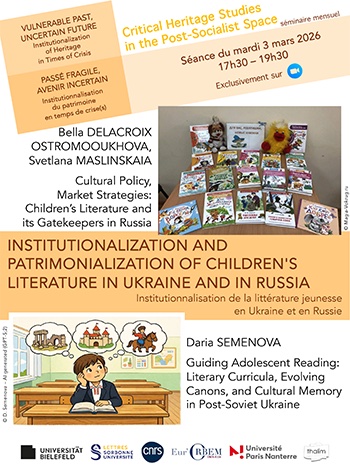
Nous aurons le plaisir d’écouter (en anglais), puis de discuter (en anglais, français, ou autre) les communications suivantes :
— Bella DELACROIX OSTROMOOUKHOVA (Sorbonne Université), Svetlana MASLINSKAIA (Université Grenoble Alpes), Cultural Policy, Market Strategies: Children’s Literature and its Gatekeepers in Russia
Soviet children’s literature was very diverse and prolific, yet only a few authors and works are still not only published and read but also rank among the bestsellers of major commercial publishers. In the first part, we will show how this ‘intangible heritage’ is incorporated into the reading practices of the parents and grandparents of child readers, who are the core target audience of commercial publishers. However, it was challenged by an entire ecosystem of independent publishing houses that implemented strategies to promote other forms of heritage: the alternative contemporary ‘world classics’ and new Russian-language literature, which these publishing houses strive to promote as part of heritage.
Throughout the 2010s, and especially after 2022, this conflict took on a political dimension, in abroader context of the ideologization of everyday life in general, and literature in particular. The ‘Soviet classics’ (the composition of which changed in relation to the bestsellers) became the moral standardand model to be adopted by the various actors supporting the state’s authoritarian policy.
— Daria SEMENOVA (University of Warsaw), Guiding Adolescent Reading: Literary Curricula, Evolving Canons, and Cultural Memory in Post-Soviet Ukraine
This presentation starts from the premise that children’s and adolescent reading, alongside school education, plays a central role in socializing new generations into a cultural community. Through these channels, young people learn what distinguishes their “imagined community” from others and how it has arrived at the present moment—that is, they acquire a framework of cultural memory. While leisure reading selected by adults or by children themselves may vary, state-approved humanities curricula serve as a key instrument through which students across a nation are introduced to a shared set of topics and interpretations of foundational historical and cultural narratives.
The presentation traces the evolution of the Ukrainian literature curriculum since independence, examining how the canon—initially inherited from the Soviet period and mechanically expanded with previously censored texts—has changed over time. One notable development has been the inclusion of recently written works with contemporary settings that address questions of cultural memory through characters relatable to adolescent readers. This shift contrasts with earlier curricular models that relied primarily on texts from more distant historical periods, which often required substantial contextualization to bridge the gap between students’ lived experience and the literary past.
Exceptionnellement, cette séance se tiendra uniquement en ligne.
Pour recevoir le lien Zoom, veuillez contacter : aleksandra.kolesnik@uni-bielefeld.de