
- Cet évènement est passé.
Critical Heritage Studies in the Post-Socialist Space. Vulnerable Past Uncertain Future Institutionalization of Heritage in Times of Crisis
7 avril /17h30 - 19h30
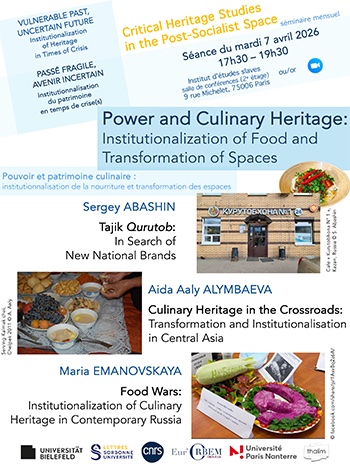
Pouvoir et patrimoine culinaire : institutionnalisation de la nourriture et transformation des espaces
Power and Culinary Heritage: Institutionalization of Food and Transformation of Spaces
- Aida Aaly ALYMBAEVA (independant researcher) :
«Culinary Heritage in the Crossroads: Transformation and Institutionalisation in Central Asia»
Drawing on ethnographic research in the Kyrgyzstani settlement of Chelpek and analysis of digital media
discourses, this paper examines how food simultaneously signifies ethnic belonging and national identity at local,
national, and digital levels. It traces how culinary practices, rooted in memory and everyday rituals, transform into
institutionalised heritage through both grassroots initiatives and state-driven narratives. Central Asia’s position as
a historical and contemporary crossroads shapes its culinary heritage, creating a space for negotiation between
nomadic/sedentary constructed dichotomy, Soviet legacies, and post-socialist nation-building. The paper extends
heritage studies by showing institutionalisation as a creative, multi-sited process that occurs within ongoing social
transformations. Instead of viewing culinary heritage as a static tradition, I suggest that it emerges through
dynamic contestations between local lived practices and formal efforts of heritage construction. This illuminates
the tensions between vulnerable pasts and uncertain futures in the post-socialist space. - Sergey ABASHIN (independant researcher) :
«Tajik Qurutob: In Search of New National Brands»
Food is one of Central Asia’s key brands, actively promoted as part of the region’s international (tourismrelated)
image. As a shared cultural heritage and the result of migration, intermingling and exchange, food also
becomes a battleground for competition between various nation states, each striving to establish its own brand of
national dishes. This tension between transnational/regional and national representations of Central Asian food
triggers numerous and sometimes heated debates, in which the ethnic origins of dishes are discussed alongside
their class-based, traditional/modern, unhealthy/healthy, and authentic/inauthentic characteristics. One such
debate concerns the question of who indeed owns the dish ‘qurutob’, which has become popular in Tajikistan in
recent years and has already spread beyond its borders. The overview of various opinions on ‘qurutob’ presented
in this paper will shed light on the identities and debates surrounding them that currently define the social and
cultural landscape of Central Asia. - Maria EMANOVSKAYA (independant researcher) :
« La soviétitude de la nourriture en Russie post-soviétique »
Since the end of the Soviet Union, questions of “culinary heritage” in Russia have largely remained
outside the direct interest of central power, developing instead through a dispersed ecosystem of regional
administrations, enthusiasts, amateur historians, chefs, and nationalist food entrepreneurs. In 2025, this relatively
informal settlement was disrupted when the Ministry of Industry and Commerce created a special commission
tasked with codifying “Russian cuisine.” This intervention has rapidly turned culinary heritage into an arena of
open conflict. Who has the authority to define the national canon, whose regional and minority foodways count as
“Russian,” and which pasts (and futures) this canon is meant to legitimate?
This presentation analyzes the controversies triggered by the new State-led codification project as a
window onto competing heritage regimes. It asks how “gastronomic patriotism” becomes institutionalized, and
how the translation of everyday food practices into official heritage generates friction between long-standing
actors of culinary heritagization and newly empowered doctrinal gatekeepers. Rather than treating these disputes
as a search for historical “truth” or ideological conformity alone, I show how heritagization operates
simultaneously as cultural governance and as an economic project, sometimes under conditions of legal or
political pressure.
Zoom Inscription : aleksandra.kolesnik@uni-bielefeld.de